The Indiana Council of Community Mental Health Centers, along with Hamilton Center, Inc., recognized Senator Greg Goode as the recipient of the 2026 Legislator of the Year Award on April 8, honoring his unwavering commitment to strengthening Indiana’s behavioral health system and championing access to care across the state.
In presenting the award, the Indiana Council said that Senator Goode has been a dedicated advocate for policies that support behavioral health services, ensuring that individuals and families have access to the care they need in their communities.
The Council also noted that his leadership at the Statehouse has helped advance critical initiatives thatimprove outcomes, expand services, and reinforce the vital role of community mental health centers.
“Community mental health impacts everyone and as the son of Galen Goode, a pioneer of the community mental health movement, this recognition deeply touches me,” Goode said. “I am so grateful for the Indiana Council and the Hamilton Center for their work in serving others. I am their partner at the Indiana statehouse.”
The Indiana Council presents the Legislator of the Year Award annually to a lawmaker who demonstrates exceptional leadership and advocacy in support of behavioral health services throughout the State. Senator Goode’s longstanding dedication and collaborative approach have made a meaningful difference for providers and the individuals they serve throughout Indiana.
“Senator Goode has been a true champion for community mental health,” said Zoe Frantz, President & CEO, Indiana Council of Community Mental Health Centers. “His leadership, passion, and partnership have helped move our system forward and ensure that Hoosiers receive the care and support they deserve.”
The Indiana Council extended its sincere congratulations and gratitude to Senator Goode for his continued service and commitment to improving the lives of Hoosiers.
The Indiana Council of Community Mental Health Centers (ICCMHC) is a non-profit organization dedicated to promoting mental health and substance use treatment services across Indiana.
Through advocacy, education, and support, the ICCMHC works to ensure that all Hoosiers have access to comprehensive, high-quality behavioral health care.
Category: Hamilton Center, Inc. News
This category contains content related to Hamilton Center, Inc. News.
2025 Hamilton Awards announced at annual dinner
Hamilton Center, Inc. hosted its annual Hamilton Awards Dinner on Tuesday, October 28, at 6:00 p.m. at Sycamore Banquet Center on the campus of Indiana State University in Terre Haute, Indiana. More than 300 staff members, community partners, and referring organizations gathered for an evening of dinner and celebration honoring this year’s Hamilton Award nominees.
The theme for the event, “Every Person, Every Journey: Strength in Every Story,” reflects Hamilton Center’s commitment to honoring the individuality of every person served and the unique path each takes toward wellness and recovery. The theme recognizes that every experience contributes to a larger story of strength, resilience, and hope, values that are deeply rooted in Hamilton Center’s mission.
“Every person has a journey to share, we are here to listen,” said Chelsea Wells, Director of Communications at Hamilton Center, Inc. “The strength, perseverance, and triumphs we observe every day offer our staff both the privilege and the pleasure of doing this important work.”
Hamilton Awards were also presented. Named in her honor, Katherine Hamilton fought for the inclusion, acceptance, and support of those struggling with mental illness in the early 1960’s. She emphasized the importance of community in her life’s work. In this spirit, Hamilton Center awards were created to recognize individuals and organizations who have significantly contributed to the cause of mental health and addiction while furthering the mission of Hamilton Center, Inc. in the community. All nominees were recognized, and winners included:
Volunteer winner: William Browne, School Resource Officer Spencer-Owen Community School Corporation: William is deeply dedicated to the students and adults he serves at the Spencer-Owen School Corporation. He developed the Hope Squad, a peer-nominated program in which students are trained by school staff to serve as trusted individuals who can connect peers in distress with mental health resources. He also created the CARE Program, designed to strengthen relationships between law enforcement and individuals in recovery through community events and outreach activities. In addition, William helped reinstate the DARE Program, which educates students about the dangers of drug use and equips them with the skills to make safe, responsible choices. To date, more than 250 students in Owen County have successfully completed the program, fostering mental health awareness, drug prevention, and community connection.
Community winner: St. Patrick’s Soup Kitchen: Supporting the Vigo County Community for over 40 years, St. Patrick’s Soup Kitchen has worked to assist those with food insecurities by providing quality food serves to those in need. At any given time, you will see over 30 volunteers handing out meals to community members from all walks of life. Approximately 100-150 individuals are served each day with over 6800 sack lunches distributed in August of this year. Volunteers there are flexible, welcoming and extremely kind. There is no judgement present, and volunteers serve quality food until the last person is fed.
Youth winner: Rylee Long, Project REACH of Northview Highschool in Clay County: What started as an idea in a notebook, has now grown into a mission to fill gaps, meet needs and let students know their community is behind them. Rylee Long developed the non-profit, Project REACH, from a simple but powerful belief that every child deserves to feel seen, supported and set up for success. Project REACH focuses not only on providing resources but also creating a movement of compassion in schools. Students walk in knowing that someone cares and is there to help.
Staff winners:
Chloe Mckinney, Outreach Mentor, Hamilton Center, Inc.: The Hamilton Center Community Closet was born from seeing firsthand that many of the students that Hamilton Center staff mentor are in need of clean and fashionable clothes for school. She recognized a need and acted – Not because she was asked to do so, but because she is a compassionate leader. The Community Closet has provided clothing not only for students in school but just this year the program distributed clothing to 500 children at the We Live event.
Daejen Hatfield, CCBHC Crisis Diversion Specialist, Hamilton Center, Inc.: Daejen serves consumers with compassion, giving them encouragement and hope through very difficult circumstances. Dedicated to serving every consumer, has assisted consumers with navigating the health insurance process and linking them to mental health services and community resources. Daejen serves with kindness and compassion with an attunement to understanding and working with the late Millennial and Gen Z populations.
Lastly, the Hamilton Center presented two special recognitions.
The Frank W. Jerse Award is presented annually to a community member who is a veteran or who has made significant contributions to advancing education in central and west central Indiana. The award honors Dr. Frank W. Jerse, a World War II veteran and Purple Heart recipient who earned his doctorate in psychology and devoted much of his career to furthering post-secondary education at Indiana State University. Dr. Jerse also played a vital role in the development of Hamilton Center, Inc.
This year’s Frank W. Jerse Award was presented to Charles Brown, whose more than three decades of service to Indiana State University left a legacy of mentorship and inclusion. As the longtime director of ISU’s Cultural Center, now named in his honor, Brown served not only as an administrator, but also as a mentor, second parent, and spiritual leader to countless students. Under his guidance, the Cultural Center grew from a small operation into a vibrant social and educational hub serving hundreds of African American students each year. Former ISU President Dan Bradley once remarked, “The Center and its programs and services is literally the house that Charlie built.” Through his leadership and compassion, Brown has positively influenced the lives of thousands of students, many of them first-generation college graduates, and has dedicated his life to service to others.
The second special recognition of the evening, the John Plasse Award, was presented in memory of Sheriff John Plasse, a true community servant. Sheriff Plasse dedicated more than 33 years to law enforcement in Vigo County, serving both as Police Chief and later as Sheriff. He also devoted over three decades to military service, retiring as a Sergeant Major with the 38th Infantry Division of the Army National Guard. Throughout his career, Sheriff Plasse exemplified leadership, integrity, and an unwavering commitment to protecting the public and bettering his community. He was also a valued member of the Hamilton Center Board of Directors, generously giving his time to support the organization’s mission.
The 2025 John Plasse Award was presented to Sergeant Ryan Plasse, the Sheriff’s son, a fitting recipient of this inaugural honor. Sergeant Plasse has served with the Terre Haute Police Department for 13 years, holding positions as patrolman, detective, and most recently, sergeant. In addition to his leadership role, he serves as a field training officer, sniper, and entry breacher for the department’s Special Response Team, and is a dedicated member of the Honor Guard. Over the course of his career, Sergeant Plasse has received numerous commendations, including the Life Saving Award, Good Conduct Medal, Unit Citation, Education Medal, Honorable Service Award, Grand Cordon, and a Certificate of Commendation. His dedication, professionalism, and service to others reflect the same values that defined his father’s legacy.
Community leaders, advocates to be honored at Hamilton Center’s 2025 Hamilton Awards
Hamilton Center Inc. will host its annual Hamilton Awards dinner on Tuesday, October 28, at 6:00 p.m. at Sycamore Banquet Center on the campus of Indiana State University in Terre Haute. Over 300 staff, community partners, and referring organizations will enjoy celebrating the 2025 Hamilton Award nominees.
The theme for Tuesday’s event, “Every Person, Every Journey: Strength in Every Story,” reflects Hamilton Center’s commitment to honoring the individuality of every person served and the unique path each takes toward wellness and recovery. The theme recognizes that every experience contributes to a larger story of strength, resilience, and hope, values that are deeply rooted in Hamilton Center’s mission.
Hamilton Awards, based upon nominations from staff and community members, will be presented in the categories of volunteer, community, youth, and staff. Named in her honor, Katherine Hamilton fought for the inclusion, acceptance, and support of those struggling with mental illness in the early 1960s. She emphasized the importance of community in her life’s work.
In this spirit, Hamilton Center awards were created to recognize individuals and organizations who have significantly contributed to the cause of mental health and addiction while furthering the mission of Hamilton Center in the community.
Another special award to be presented is the Frank W. Jerse Award, awarded annually to a community member who is a veteran or has advanced the educational system in central and west central Indiana. Being introduced this year, the John Plasse Award will honor a member of law enforcement who has demonstrated exceptional dedication to community well-being.
Keynote speaker for the evening is Indiana Senator Greg Goode, whose father, Galen Goode, served as Chief Executive Officer of Hamilton Center from 1989 until his passing in 2011. His standing committee appointments include Education and Career Development (Ranking Member), Appropriations, Elections, Family and Children Services, and the School Funding Subcommittee.
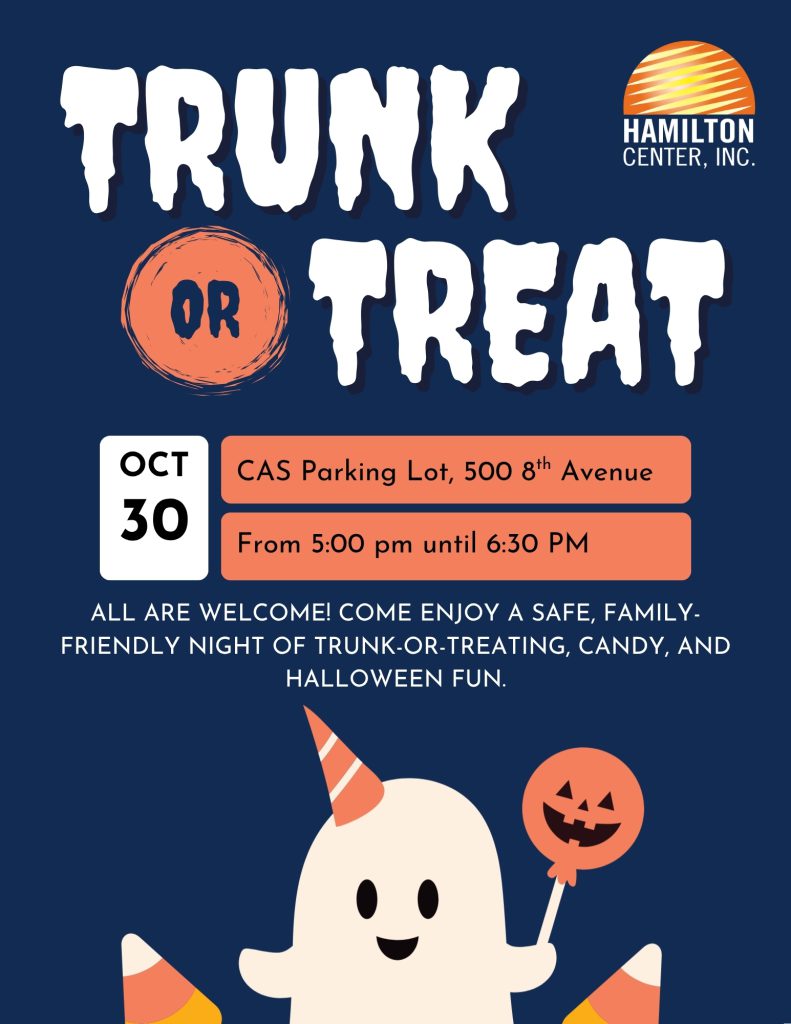
CAS to host Trunk or Treat on Oct. 30
Hamilton Center Foundation distributes more than $50K for training, materials
Hamilton Center Foundation, Inc. is pleased to announce the distribution of $50,093.29 to 17 programs serving a ten-county area in central and west central Indiana. Funding will support clinical training, program enhancements, and consumer needs across Hamilton Center’s service area.
Highlights include:
• Crisis Diversion Center: $4,000 for walkie-talkies, emergency shelter, transportation, smartphones, and personal care kits.
• Vigo County Mentoring Program: $2,000 for evidence-based practices, anti-drug curriculum, and tutoring resources.
• WIN Recovery (Vigo & Hendricks Counties): $4,351.48 for medication lock boxes to secure take-home medications.
• Vigo County Addictions Program: $931 for therapist training.
• Vigo County Clubhouse: $2,000 for décor to enhance therapeutic environment.
• Vigo, Hendricks, & Marion Counties: $3,000 for art therapy supplies.
• Sullivan County: $2,678 for EMDR training.
• Greene County – Linton: $1,285.99 for therapist training.
• Greene County – Bloomfield: $4,951.05 for therapist training and curriculum.
• Putnam County: $4,975 for clinical training and materials.
• Clay County: $4,950 for clinical training and materials.
• Owen County: $4,981.63 for therapist training and curriculum.
• Vermillion County: $4,989.14 for therapist training and curriculum.
• Parke County: $5,000 to fund services for consumers without insurance.
“These funds will directly strengthen services that make a difference in the lives of those we serve,” said Melvin L. Burks, President and CEO of Hamilton Center. “We are deeply appreciative of the Foundation’s generous support.”
“This type of support is exactly what sets the Foundation apart,” said Margie Anshutz, President of Hamilton Center Foundation and Chief Development Officer at Hamilton Center. “While other grant funding is often difficult to obtain with long application processes, Foundation dollars allow us to respond quickly to the most pressing needs within the organization.”
“Even modest contributions can create meaningful change when directed toward critical programs,” said Eileen Mann, Foundation Chair. “We are proud to see the Foundation’s resources amplifying the important work Hamilton Center does for our community.”
The Hamilton Center Foundation is a not-for-profit organization that helps ensure Hamilton Center continues to provide quality, compassionate, and effective behavioral healthcare so each person can recover to their full potential.
The mission of the Foundation is to strengthen the community by providing consistent and lasting support to Hamilton Center, ensuring that high-quality behavioral healthcare and wellness services remain available in perpetuity.
With appropriate treatment, people with mental health and addiction challenges can and do recover significantly improving their quality of life. Community members, businesses, and families can play a vital role in sustaining these services through a gift to Hamilton Center Foundation.
To give, visit www.hamiltoncenterfoundation.org or call (812) 231-8416. Payroll deduction is available for HCI employees.
CCBHC is here! New designation
to change how HCI serves public
Hamilton Center, Inc. is proud to lead the way as one of eight demonstration pilot sites included in the State of Indiana’s newly acquired Certified Community Behavioral Health Clinic (CCBHC) Medicaid Demonstration Program.
In the six months since HCI was announced as a CCBHC demonstration site, staff members have been working hard to hire additional staff and develop program guidelines for existing service areas as well as a new Mobile Crisis Unit in Sullivan County and a Crisis Response Stabilization Services office at the corporate building in Terre Haute.
Effective January 1, 2025, the whole way that HCI is delivering behavioral health in supporting its communities is changing, according to Art Fuller, Chief of CCBHC at Hamilton Center, Inc.
“CCBHC is here, and it’s here to save lives,” Fuller said enthusiastically. “We recently received what I call the ‘Golden Certificate’, and that certificate indicates that we now have a full crisis continuum at Hamilton Center. We can now provide better and faster service – especially when we’re dealing with mobile crisis runs and really trying to support those that are in crisis.”
Announced on June 4, 2024, The U.S. Department of Health and Human Services (HHS), through the Centers for Medicare & Medicaid Services (CMS) in partnership with the Substance Abuse and Mental Health Services Administration (SAMHSA) welcomed Indiana among 10 new states into the Certified Community Behavioral Health Clinic (CCBHC) Medicaid Demonstration Program, after they successfully developed the necessary state-level infrastructure and worked with providers in their states to develop programs that meet CCBHC standards.
The CCBHC Medicaid Demonstration Program provides states with sustainable funding that helps them expand access to mental health and substance use services.
“Hamilton Center has worked for several years to position itself to deliver enhanced services to our communities”, said Melvin L. Burks, Hamilton Center’s President and CEO. “We would like to express our gratitude to the State of Indiana for its leadership and all of our community partners who work with us to deliver high quality healthcare.”
CCBHCs must ensure access to a comprehensive range of services, providing care coordination when needed and incorporating evidence-based practices and other supports based on a community needs assessment.
As a CCBHC, Hamilton Center, Inc. will serve our communities by:
• Responding through Mobile Crisis to behavioral health and addiction emergencies in the community
• Enhancing 24/7/365 crisis stabilization services throughout West Central Indiana
• Integrating with the National Suicide Prevention Lifeline (988)
• Coordinating primary healthcare needs
Additionally, this newly-acquired designation allows Hamilton Center to further serve the community through continued reduction of non-emergent Emergency Department visits, diverting individuals from incarceration to treatment, increasing access to Medication Assisted Treatment (MAT), and investing in the healthcare workforce.
HCI mobile crisis services expand to Sullivan
As part of its expansion into becoming a Certified Community Behavioral Health Clinic, Hamilton Center, Inc. has expanded its mobile crisis services to Sullivan County.
HCI has operated a mobile crisis unit from its main office in Terre Haute for the past four years.
Lesli Bose, HCI’s director of crisis diversion, said the Sullivan office was chosen for the expansion due to the county’s high suicide completion rate.
The mobile crisis unit currently operates from 8 a.m. to 5 p.m., but Bose said once the facility is fully staffed it will run 24 hours a day, seven days per week.
Incoming calls will serve a 45-mile area surrounding Sullivan.
Bose noted the Sullivan office has a mini-van dedicated to these runs, and lack of transportation to the HCI office is one primary reason for the need of the service.
“Some people don’t have transportation, especially a lot of individuals that are in rural areas,” she said. “It’s quite a long way for some of them to get to an office when we’re talking about the area that we’re serving. The unit allows our team to go to wherever they are. Sometimes they’re out in the public at grocery stores or at a park, but a lot of times they’re at home.”
Bose noted the primary goal of the team is to de-escalate that crisis on scene and provide support and intervention resources.
“We hope to be able to resolve that crisis in the community,” Bose said. “If not, then they can provide assessment on-site or bring them back to an office if there’s not an appropriate location for them to be assessed in the community.“
Depending on the location, bringing the individual back to an office may happen if there is nowhere private to assess the person.
“Otherwise, they will provide that assessment in the field, and then they can determine along with the prescriber the appropriate level of care and then get them to a higher level of care if that’s what’s recommended,” she said.
Increased awareness of the program will allow it to grow as time passes, and Bose thinks it has been successful so far.
“We have been able to help some of the community partners there in the schools,” she noted. “We’ve had some other runs within the Sullivan community. It is slowly developing, but they’ve been successful in being able to get people served that aren’t able to come into offices.”
Bose said that 10 more staff members are needed to reach the around the clock goal for the mobile crisis unit. Anyone interested is encouraged to visit hamiltoncenter.org/employment to learn more about the positions and fill out an application.
Bose emphasized the importance of peer recovery specialists (staff members who are successfully in recovery) in the process of helping consumers.
“Peer recovery specialists are really effective since they’re able to provide lived experience themselves with mental health and or substance use,” she said. “They’ve been very helpful in engaging consumers, building rapport with them, increasing their motivation for change or to engage in treatment. The peers have been very, very beneficial to our team.”
Rose Shepler, health educator for the Sullivan County Health Department, is thrilled with the expansion of the mobile crisis unit and thinks it will be highly beneficial for the Sullivan County community.
“I think it’s a great idea and very much needed,” she said. “Sullivan County would benefit from resources that help to decrease successful suicide rates. Indiana’s average is actually higher than the national average, and Sullivan County specifically is higher than Indiana’s average.”
Shepler noted that Sullivan County has also taken steps itself to help with the problem, opting in for the Health First Indiana initiative. This legislation was passed in 2023 and prioritizes core services in a fatality review of children, suicide, and overdose.
“In thinking about the unit, a lot of times our law enforcement officers are responding to a mental health crisis situation and they may lack the resources to support someone in crisis,” she said. “Hamilton Center’s mobile crisis will be a valuable asset to provide that needed care and support for people in crisis.”
Award nomination shows Pritchard making big impact in short time with HCI
Adrienne Pritchard has not worked very long for Hamilton Center, Inc., but in her five months with the corporation she has made an impression on someone.
Pritchard was anonymously nominated as a 2024 Hero for Recovery in the “Recovery Coach of the Year” category. Pritchard attended the Mental Health America of Indiana awards luncheon in Indianapolis on Dec. 13.
She was not chosen as the winner of the award, but admits to being “amazed” at even being nominated considering the length of time in her position as a peer recovery specialist.
“I was amazed because I’ve had my Certified Peer Recovery Coach [CPRC] license less than six months,” Pritchard said. “It was amazing that I touched somebody enough that they felt the need to nominate me. It could have been anyone — any employee or any consumer.”
Pritchard admits that she is in the process of rebuilding her life after incarceration and drug abuse sent her on a downward path.
She served five years in the Indiana Department of Corrections at the Indiana Women’s Prison after being convicted of burglary related to funding a drug habit which had escalated after the death of a family member.
Pritchard had gotten in trouble for having marijuana in college, when she attended Lincoln College in Illinois on a basketball scholarship. She had previously attended Lincoln Trail College after a celebrated career at Terre Haute North.
While in high school, Pritchard was an honorable mention all-state selection her junior and senior years and was chosen to play in the North-South Indiana All-Star game after her senior year.
She went on to Lincoln, a private, Division II school, and was dismissed from the team after her drug use was discovered.
“I came home, and my dad passed away,” she recalled. “He was my best friend, so that’s when I started doing hard drugs. I had never done hard drugs until my dad died, and that was a very quick downhill spiral for me.”
Not surprisingly, Pritchard admits she was very upset about going to prison once she was convicted.
“Vermilion County threw the book at me,” she said. “I signed a 10-year plea, an open plea with a 10-year cap, and they gave me nine years total with six years executed [served] and three years of house arrest.”
In the end, though, Pritchard is positive that prison saved her life.
“If they would’ve put me back out on house arrest right then and there, I would be dead today,” she said. “It’s a different perspective that I have now looking back. I went to prison in 2019, but I didn’t get clean until 2022. I got released from prison in 2023.”
Pritchard did not adapt to the prison’s drug treatment well, and was actually removed from the program twice before taking advantage of a final chance.
“Any treatment program that you go through, you’re going to get out what you put into it,” she said. “I couldn’t stay out of trouble, and was kicked out of the program twice. I was always moving in and out of being in segregation.”
Pritchard recalls that the director of the program told her that her third chance would be her last one.
“She said I was either going to complete this program or you’re not, but she was not allowing me back in again,” Pritchard said. “I completed the program, and then I was asked to stay on the unit as a mentor. I taught classes and mentored other women.”
Her success in mentoring other inmates helped her to join the Hamilton Center staff after her release.
From her experiences with HCI, she has learned that major life events like the death of a parent can sometimes trigger heavy drug use — but it’s not a 100 percent occurrence.
“It’s different for everybody, but I think it’s present in a lot of cases,”she said. “ It’s usually something very traumatic or past traumas from childhood that isn’t dealt with. Mental health issues and substance abuse run hand in hand, and very rarely do you find one without the other.”
Pritchard’s status was changed from house arrest to probation, and when she’s finished with that part of the program she’ll be completely done with that part of her life.
One of the requirements for being hired as a peer recovery specialist with HCI is a successful experience with recovery, as those who know how the cycle works are best suited to help others facing similar struggles.
“I have a different perspective for consumers, especially ones that struggle with addiction because I know exactly how it feels to be where they are,” she said. “That’s why peers are so beneficial, because we do have a different understanding. We can level with the consumer on a different page than someone who’s never struggled with that problem can.”
HCI consumers appreciate having someone to talk to who has been where they are.
“They are a lot more willing to open up,” Pritchard said.
Pritchard said that whether or not a person is successful with recovery has to do with the mental aspect of being in it for the proper reason.
“You can’t want to get sober for somebody else, or you can’t get sober because the courts said you have to,” she said. “You won’t ever make it. You have to do it for you and you have to want it because it’s an everyday battle.”
Pritchard has set up some consumers two or three times in treatment facilities, and for a while they will be doing well.
“Unfortunately, relapses are a part of sobriety,” she said. “Relapses happen, and it’s what you do with that relapse.”
Pritchard, 28, could not have predicted how her life would turn out as a teenager.
She finished three years of coursework in pre-med with a minor in psychology with hopes of being a pediatric doctor.
Hamilton Center is venturing into a new era of being a Certified Community Behavioral Health Center, a designation which includes increasing its amount of mobile crisis runs to help people in their communities.
Those trips require a peer recovery specialist to be present with other staff members, and Pritchard loves her job.
“Peers don’t do their jobs for the money,” she said. “They do it because that’s what they’re passionate about. This job gives me a purpose. Not only do I get the substance use side of it, I get the mental health side, and that’s two things that I’m very passionate about.”
She has worked both day shifts and evening shifts, and recently switched to overnights.
Pritchard recently read that the importance of having a peer recovery specialist present on a visit is vital, and that there is an 86% success rate with a peer on scene.
“That’s tremendous,” she said. “Now we’re getting to a point where the Vigo County law enforcement officers will call us, and we’re building that relationship with them. It’s really come a long way.”
Pritchard plans to return to school and will major in psychology as she works to become a therapist.
“I’d love to work with little kiddos,” she said.
Pritchard is exploring the opportunities HCI provides to get tuition assistance in her quest to become a therapist.
“It’s amazing that Hamilton Center helps people achieve better things, and how there’s always room to grow,” she said. “I also appreciate whoever nominated me for that award. That means a lot to me because if I can help one person every day, that makes that day great.”
HCI benefits from city, United Way ARPA grant
The United Way of the Wabash Valley and the City of Terre Haute are pleased to announce the allocation of $750,000 through their Nonprofit Grant Program, funded by the American Rescue Plan Act (ARPA) as approved by the City Council.
This initiative will support 20 local nonprofits dedicated to serving the community.
Hamilton Center received $38,255 for new chairs to improve sanitation for staff and clients.
Mayor Brandon Sakbun expressed enthusiasm for the program, stating, “The United Way and City of Terre Haute Grant Program provides vital funding opportunities for small businesses and nonprofits.
These grants, made possible by the American Rescue Plan Act, will foster support to our nonprofit community and offer essential support to Hoosiers impacted by the pandemic and rising inflation. Programs like this embody the true spirit of local government, creating opportunities that benefit all.”
The Nonprofit Grant Program aims to alleviate operational pressures for nonprofits, enhancing their organizational capacity and development to better serve the city’s most vulnerable populations. These grants are designed to promote efficiency and effectiveness, allowing organizations to fulfill their missions more sustainability. Eligible nonprofits applied for funding to support various initiatives, including organizational planning, staff development, capital expenditures, and infrastructure improvements.
Grant amounts range from $10,000 to $50,000.
Hamilton Awards highlight of annual gala
Hamilton Center Inc. hosted its annual Hamilton Awards dinner on October 22 at the Sycamore Banquet Center on the campus of Indiana State University. Over 300 staff, community partners, and referring organizations enjoyed dinner and celebration of Hamilton Award nominees. The theme for the event, “Everyone, Everywhere” suggests several ideas, all rooted in the immense responsibility Hamilton Center has to deliver the highest quality of healthcare services to a very diverse and widespread population in central and west central Indiana. Very few things in life affect us all.
“Everyone, Everywhere” deserves health services that are accessible, timely, cost effective and of the highest quality. Hamilton Center strives to provide integrated healthcare that is person centered and meets people where they are,” stated Margie Anshutz, Chief Development Officer.
Hamilton Awards were also presented. Named in her honor, Katherine Hamilton fought for the inclusion, acceptance, and support of those struggling with mental illness in the early 1960s. She emphasized the importance of community in her life’s work. In this spirit, Hamilton Center awards were created to recognize individuals and organizations who have significantly contributed to the cause of mental health and addiction while furthering the mission of Hamilton Center, Inc. in the community.
All nominees were recognized, and winners were:
Volunteer winner, Rebecca Johnson: Rebecca is all about “paying it forward”. She has used her past life experiences to assist others struggling with addiction and working towards recovery. She was a past participant in the Parke County Drug Court. Since her graduation from the program, she has been dedicated to assisting others on their recovery journey. She leads the Celebrate Recovery meetings in Parke County two night a week and serves as a mentor and support to many. She sponsors several people going through the program showing up at court with enthusiasm, support and compassion.
Community winner, John Plasse, (given posthumously): A former Vigo County Sheriff, Plasse spent over 33 years in Vigo County law enforcement as a Police Chief and later as Sheriff. He also spent equally as long serving our country, retiring as a sergeant major with the 38th Infantry Division in the Indiana Army National Guard. Sheriff Plasse was a true community servant, devoting his time to numerous organizations including the Board of Directors at Hamilton Center. In the words of his nominator, John Plasse was a great leader, worked with integrity and was always focused on the goal of bettering others and protecting the public.
Youth winner, Bring Change to Mind (North Vigo High School): This organization empowers students to advocate for mental health awareness to help create a more empathetic and stigma free school environment. Bring Change to Mind is an evidenced based student led club available to all students. Terre Haute North’s club encourages youth to take a proactive approach to mental health and self-care while equipping club members as emerging peer advocates with the tools and skills to create real change in their communities. Representing the Club were Amanda Higgins, Valeri Kershaw, and several Club officers.
Staff winner, William Kennedy (Peer Recovery Specialist): Kennedy has only been at Hamilton Center since June of this year but has already made a tremendous impact on so many lives. He is always the first person to offer help, no matter the situation taking his job very serious and understanding the importance of the work. He finds positive light in some of the darkest situations and treats all consumers with dignity, respect and compassion. He works tirelessly to facilitate services and find placement for those struggling with addiction issues and uses his own past experiences to connect on a deeper level with the consumers he serves.
Frank W. Jerse award, Dennis Weber: This award is presented annually to a community member who is a veteran or advanced the educational system in central and west central Indiana. Dr. Jerse, for whom this award is named, served his country during World War II and received a purple heart. Upon returning from war, he received a doctorate in psychology and dedicated a significant portion of his career furthering post-secondary education at Indiana State University. He also played a vital role in the development of Hamilton Center Inc. Weber is a retired mathematics teacher and football coach. Weber is a resident of Clinton, IN and a graduate of Indiana State University. He spent close to 40 years teaching mathematics at the high school level and coached football at North Vermillion, South Vermillion, and Terre Haute South Vigo. He is a role model to students and athletes; Many students looked up to him and he always wanted students to achieve both on the field and off.